


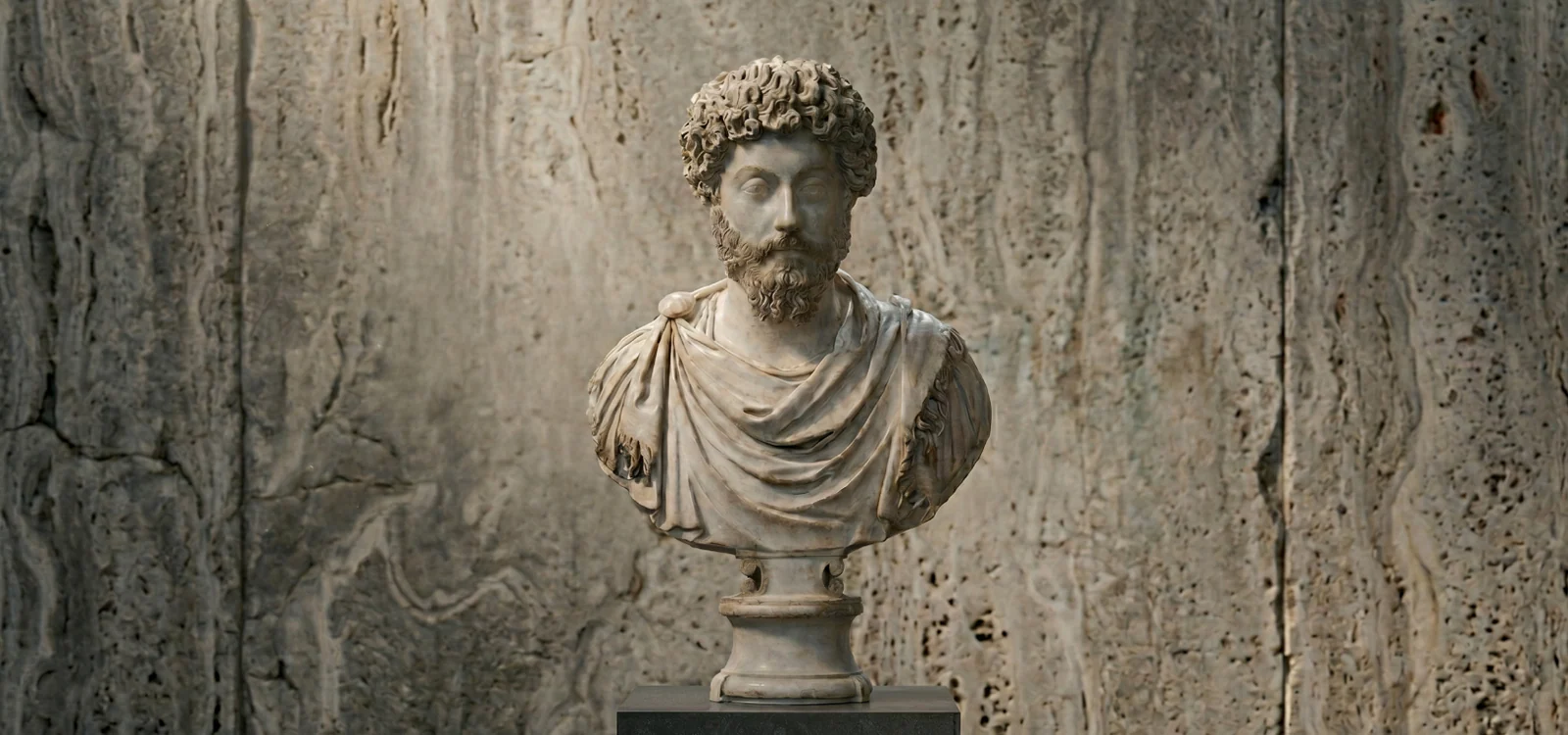
The Stoic Life
Wisdom, Philosophy and application are central to a Stoic life.
I cannot see it, but know I have a soul, I value and care for it above all else; and that makes all the difference.
Real life example of the benefits of Stoicism:
Wearing many hats in life (my partner would say too many) is sometimes a challenge to my energy levels, peace and agreeability. As a result, it is not unusual to feel it’s all a bit much, indulge in a few moments of silent complaining and wish that things would just take care of themselves.
The Stoics would not agree. Stoicism prescribes happily meeting duties and rational examination of mental activity and attitudes. Making a choice to be reasonable then prompts investigation of what truthfully is needed in a situation, which is often far more manageable than I ‘think’ it is. This approach clears away the habitual mental impression of being ‘too busy’ and the unhelpful stress it creates.
Stoicism teaches that the mental state is within my control. I can choose to not feed the feeling of being overwhelmed. I can choose to simply and happily meet the need and leave it at that. It is amazing what is possible when I surrender those reactionary negative thoughts, they are often just a barrier to fulfillment and happiness.
Stoic Wisdom:
Only that which depends on me is of interest to me.
Wisdom is understanding and separating in my mind that which depends on me from that which does not, attending fully to the former and treating the rest as indifferent. What does not depend on me is out of my control, it cannot guarantee happiness
What depends on me are my attitudes and emotions and principles.
That which does not depend on me is everything else: what other people think, do, how virtuous they are, their comings, goings and dealings, the movements of the natural world. I accept them but do not indulge in preferences or opinions about them. They cannot force me to adopt an unwise attitude, an impure emotion or abandon my principles, those things are up to me.
‘…things of the world cannot affect the soul; they lie inert outside it, and only internal beliefs can disturb it.’ Marcus Aurelius – Meditations Notebook 4.3
Happiness comes only from living virtuously
A Stoic is inspired by the life of Socrates. Even in the face of death Socrates never compromised on Virtue, truth and justice, he was willing to be put to death for false accusations instead of telling a lie or escaping from Justice. Only living truthfully is of any value, wisdom is searching for truth, discovering it, prioritising it over all else. There is no such thing as a half-truth.
Plato (Laws) identified four Cardinal Virtues: Wisdom, Self Control, Courage and Justice. The Latin word ‘cardo’ means ‘hinge’, all other goods and virtues hinge on these; without them no other true good is possible.
‘“Where virtue and spirit are present in his frame” (Virgil, Aeneid 5.363) a man is equal to the gods’. The Stoic Philosophy of Seneca – Letter ‘The Happy Life’ p. 246
A Spark of the Divine Reason
As a Stoic I understand that my truest Reason is a Spark of the Divine Reason. It is that Divine Reason which allows me to see the virtues, to identify that which depends on me, and which lights my life. This spark of Reason lives in my ‘command centre’ or ‘inner citadel’, it is not subject to the passions or weaknesses of the mind, emotions and the body. My practice as a Stoic is to honour that Spark; to nourish it and abide it, I honour my human capacity to reason in doing so.
‘…the happy life depends solely on our reason being perfect. Only perfect reason keeps the soul from being submissive and stands firm against Fortune; it assures self sufficiency in whatever situation. It is the one good which can never be impinged upon’. The Stoic Philosophy of Seneca, Letter ‘The Happy Life’. p. 239
The Order behind things
The Logos is the all-knowing and wise reason, regulator and ruler of life. It has ordered the universe wisely. As a Stoic I accept that wherever the Logos has placed me and whatever it has given me is according to Reason and Justice. I accept it and practise Virtue, which provides all that is necessary to play my part, the part assigned to me by the Logos, which in fact, is in me too.
‘After all, the universe, being made up of all there is, is one, and there’s one reality, one law, one reason that’s common to all intelligible creatures, and one truth…’ Marcus Aurelius – Meditations Notebook 7.9
Following Nature
Nature is ruled by the Logos. Therefore, whatever is natural is to be welcomed as it must accord with the Logos. Following Nature my desires will be natural and I will not wish to avoid what is natural. I will not desire what is artificial or what is unwise, invirtuous or the result of opinion. My appetites will be regulated to follow Nature and practise of the Virtue of Self Control will assure happiness.
‘…compliance with reason is not burden, but a relief. Remember that philosophy wants only what your nature wants… And what could be more delightful than satisfying nature’s wants? After all, isn’t that how pleasure beguiles us? Marcus Aurelius – Meditations Notebook 5.9
Remaining centred, not reacting
The world ever provides me with impressions. The impressions themselves create nothing without my assent. As a Stoic my rational faculty should be strengthened to discriminate true impressions from false and only assent to true impressions; having done so, my impulse for action will befit the need. Excessively passionate impulses to action should be checked, lest they disturb reason or overvalue what would otherwise be indifferent.
‘The point is that sensations and impulses belong to our animal nature, while it’s the aim of intelligent activity not to surrender its leadership and be overcome by them’ Marcus Aurelius – Meditations Notebook 7.56
‘If it’s not right, don’t do it; if it’s not the truth, don’t say it. Your impulses should be under your control’ Marcus Aurelius – Meditations Notebook 12.16
Live in the present
In the context of a lifetime, I do not possess either the past or the future. In a way, it is as if they never existed or will exist, only the present exists and it deserves my whole appreciation.
‘Don’t dwell on all the various kinds of troubles that have happened or are likely to happen in the future as well. No, focus on the present… And then remind yourself that neither the future nor the past can weigh on you, but only the present, and that the present becomes easier to bear if you take it on its own.’ Marcus Aurelius – Meditations Notebook 8.36
‘In a single day there lies open to men of learning more than there ever does to the unenlightened in the longest of lifetimes’ Seneca – Why I am a Stoic p. 84
Stoicism as a Way of Life
As a Stoic I place Wisdom as the central Good of my life. I do not leave the experience of Wisdom to chance or hope for it to come when life is difficult or by some favourable inspiration. I study Philosophy; I delight in it and the peace and guidance it brings. I choose Stoic practices for my daily life and contemplate my experience of them, constantly refining my practice and memory to create a wise disposition.
‘…if from the moment they get up in the morning they adhere to their ideals, eating and bathing like a person of integrity, putting their principles into practice in every situation they face…that is where you will see true progress embodied and find a person who has not wasted their time…’ Epictetus – Whatever is Rational is Tolerable p.17
‘No one can lead a happy life, or even one that is bearable, without the pursuit of wisdom, (and that) the perfection of wisdom is what makes the happy life, although even the beginnings of wisdom make life bearable. Yet this connection, clear as it is, needs to be strengthened and given deeper roots through daily reflection…’ Seneca – Why I am a Stoic p.26
Summary:
Practising Stoicism leads to feeling upright. It is challenging but uplifting to be reminded of one’s own large capacity for engaging in life. It allows for life to be met with clear thinking and good conscience, encouraged by the knowledge that people have been striving to do so for over two thousand years. Keep going, all will be well.
References:
Why I am a Stoic – Selected letters of Seneca, Translated by Robin Campbell – Penguin Classics 2025
Whatever is Rational is Tolerable – Epictetus extracts, translated by Robert Dobbin – Penguin Classics 2025
Meditations, The Annotated Edition – Marcus Aurelius – Translated by Robin Waterfield, Basic Books 2022
Philosophy as a Way of Life – Pierre Hadot – Blackwell Publishing 1995
The Stoic Philosophy of Seneca – Essays and Letters – Translated by Moses Hadas. 1958 W.W Norton and Company.
Discover the Benefits of Philosophy...
If you are interested in Stoicism as a philosophical movement and practical guide to living, emphasizing daily self-discipline and moral improvement, consider joining one of our philosophy classes. This term our 10-week introductory course ‘The Wisdom Within’ is scheduled to run at a choice of venues, and online.